Table of Contents
Ten years ago, buying a mattress meant spending a Saturday afternoon lying awkwardly on beds in a showroom while a salesperson hovered nearby. Then companies like Casper, Tuft and Needle, and Leesa proved that you could compress a mattress into a box, ship it to someone’s door, and let them try it at home for 100 nights. The mattress industry has not been the same since.
But the mattress-in-a-box revolution created a new kind of confusion. With hundreds of online brands promising the best sleep of your life and traditional retailers fighting back with their own deals, figuring out which buying experience actually makes sense for you is harder than ever. This guide cuts through the noise and gives you a clear framework for deciding. For the complete picture on mattress shopping, our mattress buying guide covers every step of the process.
The Core Differences at a Glance
| Factor | Mattress-in-a-Box | Traditional Store |
|---|---|---|
| Price Range (Queen) | $500 – $2,000 | $800 – $4,000+ |
| Try Before Buying | No (home trial instead) | Yes (showroom) |
| Trial Period | 100 – 365 nights | 30 days or none |
| Delivery | Compressed in box, 2-5 days | White glove or self-pickup, same day possible |
| Setup | DIY (unbox, unroll, wait to expand) | Professional delivery team (usually extra cost) |
| Old Mattress Removal | Rarely included | Often included or available |
| Negotiation | Fixed pricing, occasional sales | Prices often negotiable |
| Salesperson Pressure | None | High (commission-based) |
| Common Materials | Memory foam, hybrid, latex | Innerspring, hybrid, pillow-top, all types |
| Average Quality | Good to excellent | Varies widely (floor models to luxury) |
- You are shopping for a new mattress and unsure whether to buy online or in-store
- You have heard conflicting advice about bed-in-a-box quality versus traditional brands
- You want to understand the real trade-offs, not marketing claims from either side
- You need a decision framework based on your specific situation
- People who already know exactly which mattress they want — just buy it
- Anyone looking for a specific brand review — check our brand comparison guide instead
The Case for Mattress-in-a-Box
The bed-in-a-box model disrupted the mattress industry for legitimate reasons. Understanding what it does well — and where it falls short — helps you decide if it matches your priorities.


Lower Prices Without Lower Quality
The biggest advantage of bed-in-a-box brands is price, and the savings are real, not marketing tricks. Traditional mattress retailers operate showrooms, employ sales staff, and pay commissions. These costs get baked into the mattress price. A mattress that costs $800 wholesale often sells for $2,000 or more in a showroom.
Online brands skip most of those costs. They sell directly from factory to consumer, usually through a single website. The result is that a high-quality hybrid mattress from an online brand costs $800 to $1,400, while a comparable mattress in a store costs $1,500 to $2,500. The materials are often identical or very similar — the same memory foam suppliers, the same coil manufacturers.
Home Trial Eliminates the Showroom Problem
Spending 10 minutes lying on a mattress in a brightly lit showroom tells you almost nothing about how it will feel after 8 hours in a dark bedroom. You cannot fall asleep in a store. You cannot test how the mattress responds to your sleeping position over multiple nights. You cannot evaluate whether you wake up with pain after a week.
The home trial solves this completely. Most bed-in-a-box brands offer 100 to 365 nights to sleep on the mattress in your actual bedroom before deciding. If it does not work, you get a full refund and they arrange pickup. This is a dramatically better testing environment than any showroom.
No Sales Pressure
Mattress showroom salespeople work on commission. Their incentive is to sell you the most expensive mattress they can, not the one that actually matches your needs. Upselling is constant — the $1,200 mattress is always “almost as good” as the $2,000 one, which is “definitely worth the upgrade.”
Online shopping eliminates this entirely. You research at your own pace, compare specifications and reviews, and make a decision without anyone standing over you. For tips on navigating the research process, our article on buying a mattress online covers essential steps.
The Case for Traditional Store-Bought Mattresses
Despite the rise of online brands, traditional mattress stores are not going away — and they have genuine advantages that matter for certain buyers.
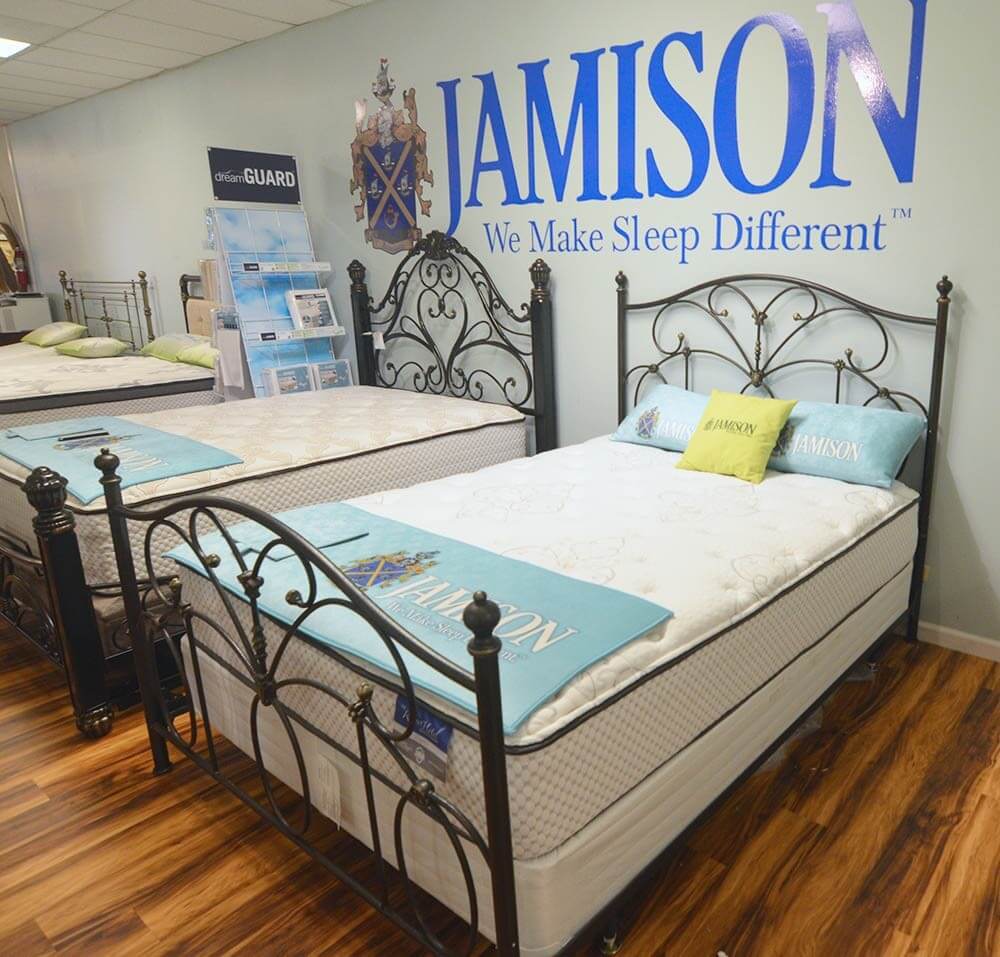
You Can Test Before You Buy
Some people simply cannot buy a mattress without lying on it first. This is not irrational. Firmness preference is highly personal, and what one person calls “medium” another calls “firm.” If you have never bought a mattress online and the idea of spending $1,000 on something you have never felt makes you anxious, a showroom visit solves that problem immediately.
The key is using the showroom intelligently. Lie in your actual sleep position for at least 10 minutes on each mattress you are considering. Ignore what the salesperson says about the mattress being “the most popular” or “perfect for everyone.” Trust your body. If you want more guidance on what to evaluate during an in-store visit, see our online vs local mattress store guide.
Immediate Availability
When your old mattress breaks down or you need a mattress for a guest arriving tomorrow, a bed-in-a-box with a 3-to-5-day shipping window does not help. Traditional stores often offer same-day or next-day delivery on in-stock models. Some even let you take a mattress home in your vehicle the same afternoon.
White Glove Service as Standard
Most traditional retailers offer delivery, setup, and old mattress removal as part of the purchase. The delivery team carries the mattress into your bedroom, places it on your frame, and hauls away the old one. With bed-in-a-box, you handle setup yourself — which means unboxing an 80-to-100-pound roll, maneuvering it onto your bed frame, and waiting hours for it to expand.
There is one notable exception: Saatva, an online brand that includes free white glove delivery as standard. It bridges the gap between online convenience and in-store service. Our Saatva mattress review covers their delivery experience in detail.
Heritage Brands with Decades of R&D
Companies like Sealy, Simmons (Beautyrest), and Stearns and Foster have been engineering mattresses for 50 to 150 years. Their premium lines use coil systems, comfort layers, and support technologies refined through decades of research and manufacturing. Not every legacy brand mattress is great — their entry-level models can be disappointing — but their flagship products represent the pinnacle of traditional mattress engineering. To understand these brands better, our store mattress buying guide explains when traditional makes sense.
Quality Comparison: Are Bed-in-a-Box Mattresses Actually Good?
This is the question most people are really asking, and the honest answer is: the best bed-in-a-box mattresses are excellent, and the worst are terrible — exactly like traditional store mattresses.
The top online brands — Helix, Nectar, Purple, Brooklyn Bedding, WinkBed — use high-density foams, quality steel coils, and durable cover fabrics. Their mattresses perform comparably to traditional mattresses priced 30 to 50 percent higher. Independent sleep labs and review organizations consistently rate the best online brands alongside or above mid-range traditional brands.
Where quality varies is at the bottom of the market. A $200 mattress-in-a-box from an unknown brand uses cheap, low-density foam that will sag within a year. Similarly, a budget traditional mattress from a department store clearance sale may use outdated coil systems with minimal comfort padding.
The rule is the same regardless of buying channel: check the foam density (1.8 pounds per cubic foot minimum for durability), the coil gauge and count (if hybrid), and the warranty terms. These tell you more about quality than whether the mattress arrives in a box or on a truck.
Price Comparison: Where Your Money Actually Goes
Understanding the cost structure of each channel explains why prices differ and helps you find the actual value.
With a bed-in-a-box brand, roughly 40 to 50 percent of the price goes to materials and manufacturing, 20 to 30 percent to marketing and customer acquisition, and the rest to operations, shipping, and margin. The direct-to-consumer model keeps overhead low.
With a traditional retail mattress, roughly 25 to 35 percent goes to materials and manufacturing, 30 to 40 percent to retail markup including showroom costs and sales commissions, and the rest to marketing, distribution, and margin. The physical retail infrastructure is expensive.
This means that at the same price point, a bed-in-a-box mattress typically has more money allocated to actual materials. A $1,200 online mattress and a $1,800 store mattress often contain comparable components. The $600 difference is largely showroom cost, not quality.
The Return Experience: A Critical Difference
Bed-in-a-Box Returns
Most online brands offer hassle-free returns within the trial period. You contact customer service, they arrange a charity pickup or disposal service, and you receive a full refund. Some brands charge a return shipping fee ($50 to $100), but many do not. The process is typically painless and takes 1 to 2 weeks.
Traditional Store Returns
Return policies at brick-and-mortar stores are notoriously restrictive. Many offer a 30-day “comfort guarantee” that charges a 15 to 20 percent restocking fee. Some require you to pay for a second delivery. And some stores have a no-return policy entirely — once you accept delivery, the mattress is yours. Always read the return policy before buying from a store, and get it in writing.
Durability: Does One Last Longer?
Durability depends on materials and construction, not on the sales channel. A high-density memory foam mattress ordered online will last just as long as the identical foam used in a store-bought mattress. A cheap online mattress will sag faster than a quality store mattress, and vice versa.
That said, bed-in-a-box brands tend to use newer foam formulations and hybrid designs, while some traditional brands still rely on older innerspring technology with thin comfort padding. The newer designs are not automatically better, but they often include features like zoned support and gel-infused cooling that older traditional designs lack.
The best indicator of durability in either channel is foam density (for foam mattresses), coil gauge and count (for hybrids and innerspring), and the warranty terms. A 10-year warranty that covers sagging greater than 1 inch is the industry standard you should expect from any mattress over $500.
The Hybrid Approach: Best of Both Worlds
Increasingly, the line between mattress-in-a-box and traditional is blurring. Several smart approaches combine the best of both:
Try in a showroom, buy online. Many bed-in-a-box brands now have showrooms or partnerships with retail stores where you can test their mattresses. Purple, Casper, and Helix all have physical locations in major cities. Test the firmness in person, then order online at the (usually lower) web price with the full trial period.
Use the trial period strategically. Order an online mattress during a sale, try it for 30 days minimum, and return it free if it does not work. Then visit a store armed with specific knowledge of what firmness and feel you actually need. This approach uses the home trial as free education.
Consider Saatva for online luxury with store-level service. Saatva operates as an online brand but delivers with white glove service, sets up your mattress, and removes the old one — the full traditional experience at online pricing.
Our Verdict: Choose Based on Your Situation
Choose mattress-in-a-box if: You want to save 20 to 40 percent versus comparable store mattresses. You are comfortable researching online and reading reviews. You value a long trial period to test at home. You do not need the mattress immediately. You can handle unboxing and setup yourself or have someone to help.
Choose a traditional store mattress if: You absolutely need to test firmness before committing. You need a mattress today or tomorrow. You want professional delivery and old mattress removal included. You have difficulty with physical setup. You prefer shopping with a knowledgeable salesperson who can answer questions in real time.
Choose the hybrid approach if: You want the best value with the least risk. Test in a showroom, buy online at a lower price, and use the home trial as your real testing period. This works especially well with brands like Purple and Casper that have both showrooms and online sales.
The worst decision is buying a mattress purely based on price from either channel. A cheap online mattress and a cheap store mattress will both disappoint. Invest in quality materials regardless of where you buy. For our top recommendations across every price range and category, see our best mattresses 2026 guide, and to compare specific brands head-to-head, check our brand comparison guide.
FAQ: Mattress-in-a-Box vs Traditional
Are mattress-in-a-box mattresses as good as store-bought?
The best ones are comparable or better at the same price point because more of your money goes to materials rather than retail overhead. The worst ones are poor quality, just like budget store mattresses. Quality depends on materials and construction, not the sales channel.
How long does a mattress-in-a-box take to expand?
Most reach full size within 2 to 4 hours, but manufacturers recommend waiting 24 to 48 hours before sleeping on it to allow complete expansion and off-gassing of manufacturing odors. Hybrid models with coils may expand faster than all-foam models.
Can you negotiate mattress prices at a store?
Yes. Traditional mattress stores have significant markup, and salespeople usually have authority to offer discounts. A reasonable target is 15 to 25 percent off the listed price. Ask for the discount directly — do not wait for them to offer it.
Is it safe to buy a mattress without trying it?
With a 100-plus night trial period and free returns, the risk is minimal. You will learn more about a mattress by sleeping on it for two weeks than by lying on it for 10 minutes in a store. The trial period is your safety net.
Why are store mattresses so much more expensive?
Showroom rent, sales commissions, delivery fleet maintenance, and multi-step distribution chains all add cost. A mattress that costs a manufacturer $400 to produce may wholesale at $800, then retail at $1,800 to $2,500 after the store adds their margin.
Can I return a mattress-in-a-box after the trial period?
No. Once the trial period ends, the return option closes. This is why it is important to genuinely test the mattress during the trial — sleep on it for at least 30 nights before deciding. If you are on the fence at the end of the trial, return it. You can always buy again later. For more on what to evaluate during a trial, our mattress buying guide covers the full process.
Ready to Start Shopping?
Browse our best mattresses 2026 guide for top picks across both online and traditional brands. Compare leading brands in our brand comparison, or get the complete buying walkthrough in our mattress buying guide.