Table of Contents
Water pillows are becoming increasingly popular. Does one deserve to be on your bed? Let’s look at their advantages and disadvantages. But before we do, let me describe exactly what a water pillow is.
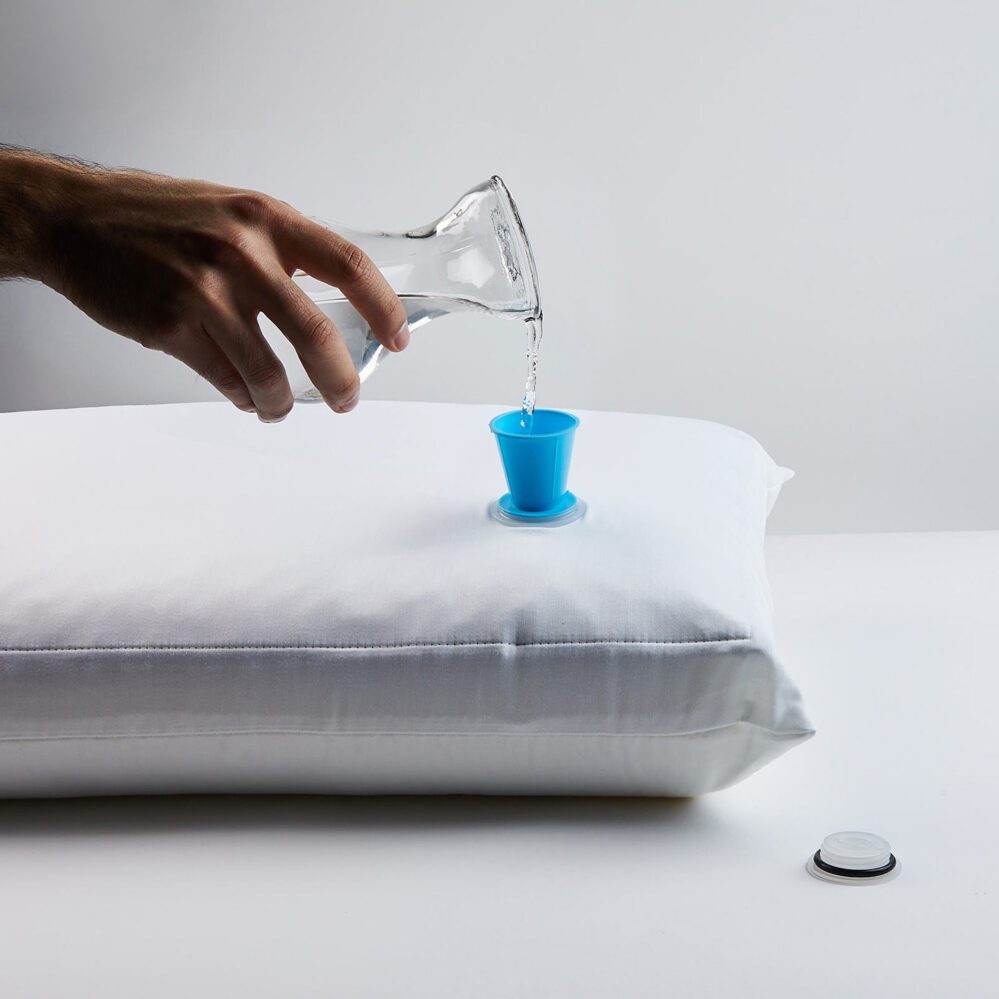
A water pillow is not merely a pillow filled with water. Rather, in addition to having a water bladder secured at the base, the pillow has a polyester fiber layer that floats on top. In other words, the pillow could more precisely be called a water / fiber pillow.
One of the most significant things to know about water-based pillows is that they have been shown in numerous credible studies, including a published clinical study conducted at Johns Hopkins School of Medicine, to decrease pain and enhance quality of sleep.
Water Pillows Advantages
Just as a waterbed conforms and contours to your body, a water pillow conforms and contours to your head and neck area, allowing them to fully relax without experiencing pressure points.
With a water pillow, the water inside instantly adjusts to maintain correct head and neck support as you move. The pillow’s contouring properties are helped by the fact that the pillow is not likely to clump, shift, or develop hollow spots.
Another advantage is that you can adjust the water level inside by adding or removing water. This allows you to affect the loft and firmness of the pillow to meet your preferences. The more water the pillow has, the higher and firmer it will be.
Water Pillows Disadvantages
The pillows can be heavy since they are filled with water. Fully filled they can weigh 15 pounds or more. This can make moving them and making the bed difficult and potentially dangerous to someone with a bad back.
Another disadvantage is that the water inside the pillow can make noise when your head is on it if you don’t remove the air fully from the bladder.
Related: best mattresses of 2026
Related: compare mattress brands
Related: best pillows for side sleepers
Related: cooling vs regular pillow
Related: how your mattress affects your body
Related: mattress firmness guide
Related: best cooling mattresses
Related: gel memory foam for hot sleepers
Related: best mattresses for side sleepers
Related: best RV mattress
Related: best mattresses for heavy people
Related: innerspring vs hybrid vs memory foam
Related: memory foam vs latex topper
Related: king vs queen mattress
Related: mattress sizes guide
Related: mattress in a box vs traditional
Related: best mattress toppers
Choosing the Right Pillow for Your Sleep Style
Your pillow choice should complement your mattress and sleeping position to create a sleep system that keeps your spine in proper alignment from head to toe. Side sleepers generally need a thicker, firmer pillow (5-7 inches of loft) to fill the space between the shoulder and ear, keeping the neck and head aligned with the spine. Back sleepers typically perform best with a medium-loft pillow (3-5 inches) that supports the natural curve of the cervical spine without pushing the head too far forward. Stomach sleepers need the thinnest pillow possible (or no pillow at all) to prevent neck hyperextension that can lead to chronic pain and stiffness. If you change positions throughout the night, an adjustable-fill pillow that allows you to customize the loft offers the most versatile solution.
How Often Should You Replace Your Pillow?
Pillows accumulate dust mites, dead skin cells, body oils, and moisture over time, creating an increasingly unhygienic sleep surface that can exacerbate allergies and respiratory issues. Most sleep experts recommend replacing pillows every 1-3 years, depending on the fill material: synthetic fiber pillows have the shortest effective lifespan (12-18 months), down and feather pillows last 2-3 years with proper care, memory foam pillows maintain their properties for 2-3 years, and latex pillows can perform well for 3-4 years. A quick freshness test: if your pillow has a persistent odor even after washing, shows visible yellow staining that penetrates through the protector, or no longer springs back when folded in half, it is time for a replacement. Investing in a quality pillow protector and washing your pillowcase weekly can extend the useful life of any pillow by reducing the accumulation of contaminants that break down materials over time.